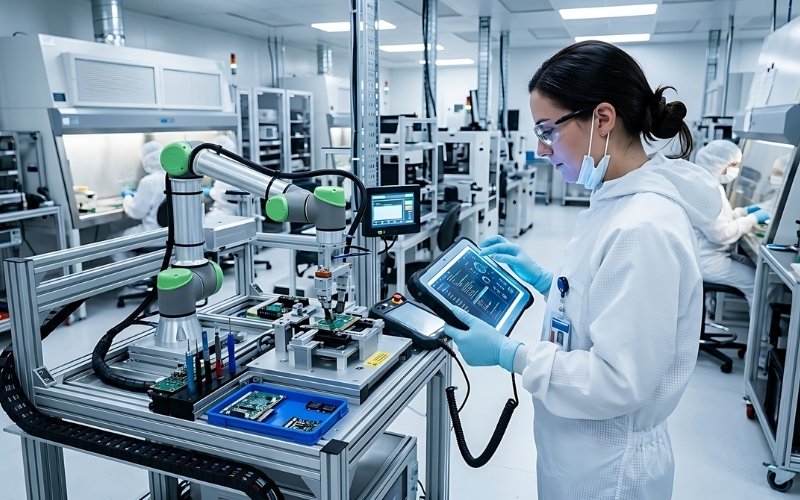

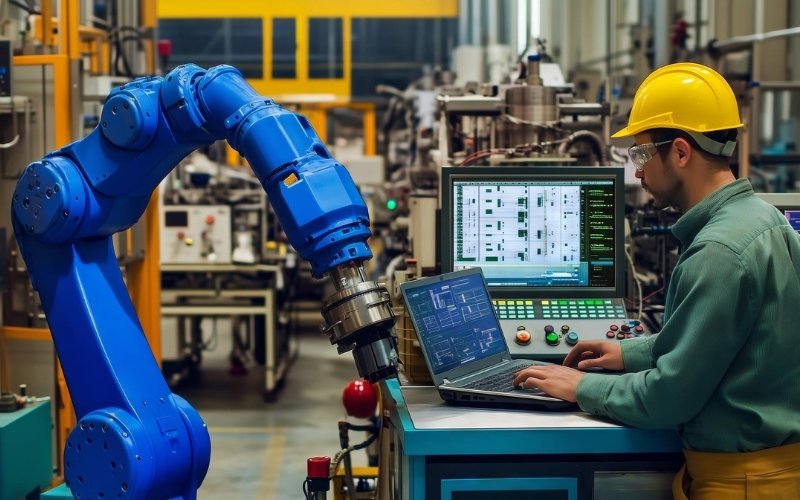
Industrial automation is transforming how manufacturing plants, production lines, and industrial facilities operate. As businesses move towards connected manufacturing and smarter production environments, Programmable Logic Controllers (PLCs) continue to play an important role in controlling machines, coordinating processes, and connecting industrial equipment.
Siemens PLC systems are widely used in industrial automation architectures involving machine control, process automation, HMI, SCADA, and industrial networking.
For manufacturers exploring Siemens PLC India solutions, understanding PLC functionality, platform selection, system integration, and modernization requirements is essential for building an automation architecture aligned with operational needs.
In this guide, we explore how Siemens PLC-based industrial automation works, the role of S7-1200 and S7-1500 platforms, integration with other automation technologies, and considerations for upgrading existing industrial systems.
What Is a PLC in Industrial Automation?
A Programmable Logic Controller (PLC) is an industrial control computer designed to monitor inputs, execute programmed logic, and control connected equipment.
Unlike conventional computers used for general-purpose applications, PLCs are designed for industrial control environments involving machines, sensors, actuators, and production equipment.
A typical PLC-based automation system includes:
- Input devices such as sensors and switches
- PLC CPU and input/output modules
- Programmed control logic
- Output devices such as motors, valves, and actuators
- HMI for operator interaction
- Industrial communication networks
The PLC receives information from connected devices, processes the programmed instructions, and sends control signals to the relevant equipment.
This makes PLCs an important component of modern Industrial Automation Systems.
Why Siemens PLC Systems Are Used in Industrial Automation
Siemens PLC platforms form part of industrial automation architectures used across manufacturing, machine automation, and process applications.
A PLC-based system can be integrated with multiple automation technologies to create a coordinated control environment.
1. Machine and Equipment Control
PLCs manage programmed machine sequences, equipment functions, and control operations.
2. Production Line Automation
PLC systems can coordinate connected machines and equipment across production lines.
3. HMI Integration
HMI systems provide operators with a graphical interface to monitor equipment, view alarms, and interact with applicable machine or process parameters.
4. SCADA Connectivity
PLC systems can communicate with SCADA platforms for supervisory monitoring and visualization across larger industrial systems.
5. Industrial Networking
Industrial Ethernet and other communication technologies connect PLCs with automation components and higher-level systems.
6. Automation Modernization
PLC migration and upgrades can form part of broader plant modernization initiatives.
Siemens S7-1200 Automation
The Siemens S7-1200 is a compact PLC platform used in industrial automation applications requiring flexible control.
It can be incorporated into automation systems involving:
- Machine control
- Production equipment
- Compact automation applications
- HMI integration
- Industrial networking
- Remote I/O
- Small and medium automation systems
Where Can S7-1200 Be Used?
S7-1200-based systems can be considered for machine automation, equipment control, and production applications where a compact PLC architecture meets the project requirements.
When integrated with HMI, drives, and other automation components, the PLC becomes part of a coordinated industrial control system.
Siemens S7-1200 G2 Automation
Siemens S7-1200 G2 represents the next generation of the S7-1200 PLC platform.
It can be considered for modern machine and production automation applications where the control architecture is planned around the platform’s supported functionality.
Potential integration areas include:
- Machine automation
- Production equipment
- HMI systems
- Industrial networking
- Drives and motion applications
- Connected automation systems
The selection of S7-1200 or S7-1200 G2 should be based on application requirements, hardware compatibility, engineering requirements, and the intended automation architecture.
Siemens S7-1500 Automation
The Siemens S7-1500 PLC platform is used for advanced industrial automation and control applications.
It can be integrated with:
- HMI systems
- SCADA platforms
- Industrial Ethernet
- Drives
- Distributed I/O
- Industrial PCs
- Higher-level plant systems
S7-1500-based automation can be considered for applications involving multiple connected components, machine coordination, and integrated industrial control requirements.
The appropriate PLC platform depends on the complexity of the application, required functionality, system architecture, and project specifications.
How PLC, HMI and SCADA Work Together
A PLC does not operate in isolation in a connected industrial automation architecture.
It works with other technologies to provide machine control, operator interaction, and supervisory monitoring.
PLC – Control Layer
The PLC executes programmed logic and manages connected equipment.
HMI – Operator Interface
The HMI allows operators to view machine information, monitor equipment status, and interact with applicable control functions.
SCADA – Supervisory Monitoring
SCADA provides visualization and supervisory monitoring across larger automation systems.
Typical Industrial Automation Architecture
Sensors & Field Devices → PLC → Industrial Network → HMI / SCADA → Plant-Level Monitoring
This integrated approach connects machine-level control with higher-level operational visibility.
Applications of Siemens PLC in Industrial Automation
Siemens PLC systems can be incorporated into different industrial environments depending on process and equipment requirements.
Pharmaceutical Manufacturing
PLC systems can form part of automated production and process-control architectures in pharmaceutical manufacturing.
When integrated with HMI, SCADA, and applicable validation processes, automation systems can support operational visibility and structured control.
Food & Beverage
PLC-based automation can support machine control, production equipment, and processing-line operations.
Process Industries
PLCs can be integrated with instrumentation, control systems, and supervisory monitoring technologies.
Industrial Manufacturing
PLC systems provide control for machines, production equipment, and connected manufacturing operations.
Industrial Machinery & OEMs
Machine builders can incorporate PLC-based control architectures into industrial equipment and automation solutions.
Siemens PLC Migration: Modernizing Existing Automation Systems
Many industrial facilities operate with existing PLC-based systems that may require modernization as operational requirements and automation technologies evolve.
Siemens PLC Migration involves evaluating an existing control architecture and planning its transition to a suitable PLC platform.
A migration project may involve:
- Existing PLC system assessment
- Hardware and application evaluation
- Migration planning
- PLC engineering
- HMI and SCADA integration
- System testing
- Commissioning
PLC migration may also be considered alongside HMI Upgrade, WinCC Migration, SCADA Migration Services, and broader Automation System Upgrade initiatives.
The migration approach should account for existing equipment, operational requirements, compatibility, and project-specific risks.
PLC Integration with Industrial Digitalization
Industrial digitalization extends automation beyond machine-level control by connecting operational data with monitoring and analytics systems.
PLC systems can contribute to this architecture by providing operational information from connected machines and processes.
When integrated with industrial networks, SCADA, Industrial PCs, and digitalization platforms, PLC-based systems can support:
- Real-Time Production Monitoring
- Equipment Status Visibility
- Production Data Collection
- IT-OT Integration
- Industrial Data Analytics
- Connected Factory Solutions
- Smart Factory Automation
This creates opportunities to connect plant-floor automation with broader manufacturing information systems.
Key Considerations When Selecting a Siemens PLC
Selecting a PLC requires an understanding of the application and the overall automation architecture.
Application Complexity
Identify whether the system is intended for machine control, production-line automation, or process applications.
Input and Output Requirements
Evaluate the connected sensors, actuators, equipment, and required I/O configuration.
HMI and SCADA Integration
Consider the required operator visualization and supervisory monitoring architecture.
Communication Requirements
Evaluate the industrial networking and communication requirements of connected devices.
Existing System Compatibility
For modernization projects, review existing hardware, application logic, interfaces, and connected equipment.
Future Expansion
Consider the possibility of future equipment additions, automation upgrades, and plant digitalization initiatives.
How Precise Supports Siemens PLC-Based Automation
Precise Industrial Solutions is a Siemens Authorised System Integrator providing engineering, automation, and digital solutions for industrial applications.
Its automation portfolio includes PLC, DCS, HMI, SCADA, control systems, industrial electrical infrastructure, and plant digitalization solutions.
Precise supports industrial automation through:
- Siemens PLC-based automation
- S7-1200 and S7-1500 automation solutions
- PLC and HMI integration
- PLC and SCADA integration
- PLC Control Panel solutions
- Automation engineering
- PLC migration and modernization
- Testing and commissioning
- Industrial digitalization integration
By combining automation engineering and system integration, Precise helps connect control systems, equipment, and operational information within industrial environments.
Frequently Asked Questions
What is Siemens PLC India?
Siemens PLC India refers to Siemens Programmable Logic Controller technologies and related automation solutions used across industrial applications in India, including machine automation, production lines, and process control.
What is the difference between Siemens S7-1200 and S7-1500?
S7-1200 is a compact PLC platform, while S7-1500 is used for advanced industrial automation applications. Selection depends on application complexity, functionality, system architecture, and project requirements.
What is Siemens S7-1200 G2?
Siemens S7-1200 G2 is the next generation of the S7-1200 PLC platform, intended for modern automation applications. Its suitability depends on the required functionality and application design.
Can Siemens PLCs be integrated with HMI and SCADA?
Yes. Siemens PLC systems can be integrated with HMI for operator interaction and SCADA for supervisory monitoring and visualization.
What is Siemens PLC Migration?
Siemens PLC Migration involves upgrading or transitioning an existing PLC-based control system to a suitable newer platform as part of an automation modernization project.
What industries use Siemens PLC systems?
Siemens PLC systems can be used in pharmaceutical manufacturing, food & beverage, process industries, industrial manufacturing, production lines, and industrial machinery applications.
What is the role of a Siemens Authorised System Integrator?
A Siemens Authorised System Integrator combines Siemens automation technologies with engineering and system-integration expertise to design and implement automation solutions according to project requirements.
Does Precise provide Siemens PLC solutions?
Yes. Precise Industrial Solutions provides Siemens-based automation solutions, including PLC integration, HMI and SCADA connectivity, PLC control panels, and automation modernization support.
Conclusion: Building Connected Industrial Automation with Siemens PLC
Siemens PLC systems provide an important control foundation for machine automation, production lines, and industrial processes.
From S7-1200 and S7-1200 G2 to S7-1500 automation, the right PLC architecture depends on application requirements, system integration, and long-term modernization considerations.
With PLC, HMI, SCADA, industrial networking, and digitalization expertise, Precise Industrial Solutions supports connected automation architectures for modern manufacturing environments.
Looking to implement or modernize your PLC-based automation system? Connect with Precise to discuss your industrial automation requirements.